product · development · 2025 (Live)
B150 Product Marketplace
The platform where builders build the future
View live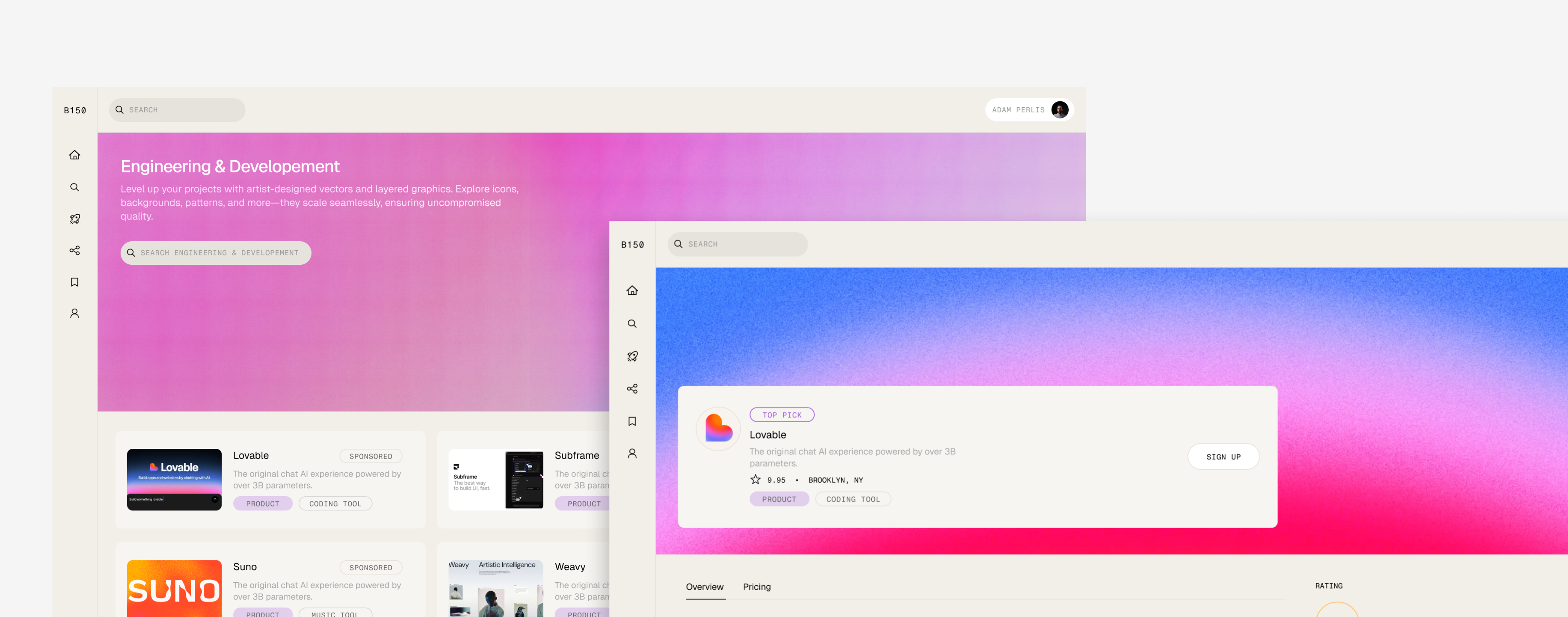 Expand
B150 Product Marketplace
We built the B150 marketplace as a replacement for Product Hunt. Distribution is the moat especially as building has become cheaper and easier. B150 exists to bridge the gap between building and distribution.
TLDR
We designed and built this project incorporating AI as a partner from research to live product.
Distribution is getting difficult and builders need a place to share their work and build an audience they own. That is why we built B150 marketplace.
Our design process involved live iterations where we thought through UX decisions and testing it live to see if it works. Our process shows how AI compresses long processes into work done in minutes.
The Challenge
Building has changed. The tools got better; the ecosystem didn’t.
A solo founder can validate a problem on Friday, build with AI over the weekend, and ship by Monday. But the platforms meant to support them are stuck in old patterns:
- A focus on "launch-day-hype" that does not translate beyond that
- Career sites are optimised for career story and less of a builder's story
- Communities do not find the right products they need
- Feedback is scattered which makes it hard to grow
Our Findings
In our research, builders kept repeating the same frustrations:
“I can build fast, but getting credible feedback is almost impossible.”
“Everything is hype. No one tells you the hard truth.”
“I want to find people building what I actually care about.”
“There’s nowhere to show the story behind the product.”
This became the core hypothesis behind B150 - Bridging the gap between builders, their story and their audience
The User Persona
To understand who we are building for, we had to ask "How Might We?" questions:
- How might we help builders get credible feedback?
- How might we surface high-signal products without gatekeeping?
- How might we design for trust that builds over time?
Through surveys and user interviews, we landed on four personas. Each group had different needs.
- Builders: Who need discovery and collaboration
- Investors: who want to see traction over time and not just launch-day hype
- AI Creatives: who needed their own space depending on their medium
- Audience: Who just want to watch the wonders of building and connect.
B150 Marketplace
A space where you can discover softwares, tools, resources and creative assets created by fellow builders. The focus was to build in a way that ensures that post-launch, builders and creatives find consistent value in the product.
My responsibilities:
- Define the MVP scope
- Shape the marketplace experience through the UX research
- Design + engineer core flows (listing, product pages, launch, review system)
- Stress-test design decisions through real implementation with Cursor + Figma MCP
- Keep the UX grounded in research and category nuance
Design–Dev Feedback Loop
Working in Cursor + Figma MCP meant I could move from idea → pixels → working code in hours, stress-testing designs before they hit engineering. Owning both sides let me catch subtle UX issues:
- Cards too dense: Reorganized hierarchy, added progressive disclosure
- Forms felt painful: cut 40% of fields, made tone conversational
- Pricing unclear: added transparent breakdown
- Listings overwhelming: added filters, infinite scroll, “Recently Updated”
Final Deliverables
Although pre-launch, this project produced clear outcomes. We built;
- A working community-builder flywheel where builder can build, share and market all in the same place
- A scalable category framework as we expand from product
- We rethought the review process to involve both independent reviewers, internet feedbacks and a designated judges
- B150 now has a marketplace layer that can support profile growth, product evolution, and meaningful discovery.
Reflection
The project evolved faster than we could design it on screen. We made a lot of decisions on the fly using AI-assisted tools to craft critical UX decisions.
- We caught friction that doesn’t appear in mockups
- We moved faster in early iteration
- Personally, I gained a deeper understanding of code vs figma tradeoffs